
Back to all articlesDental Technology Dr. Muhammad Rahim, DMDOctober 13, 202611 min read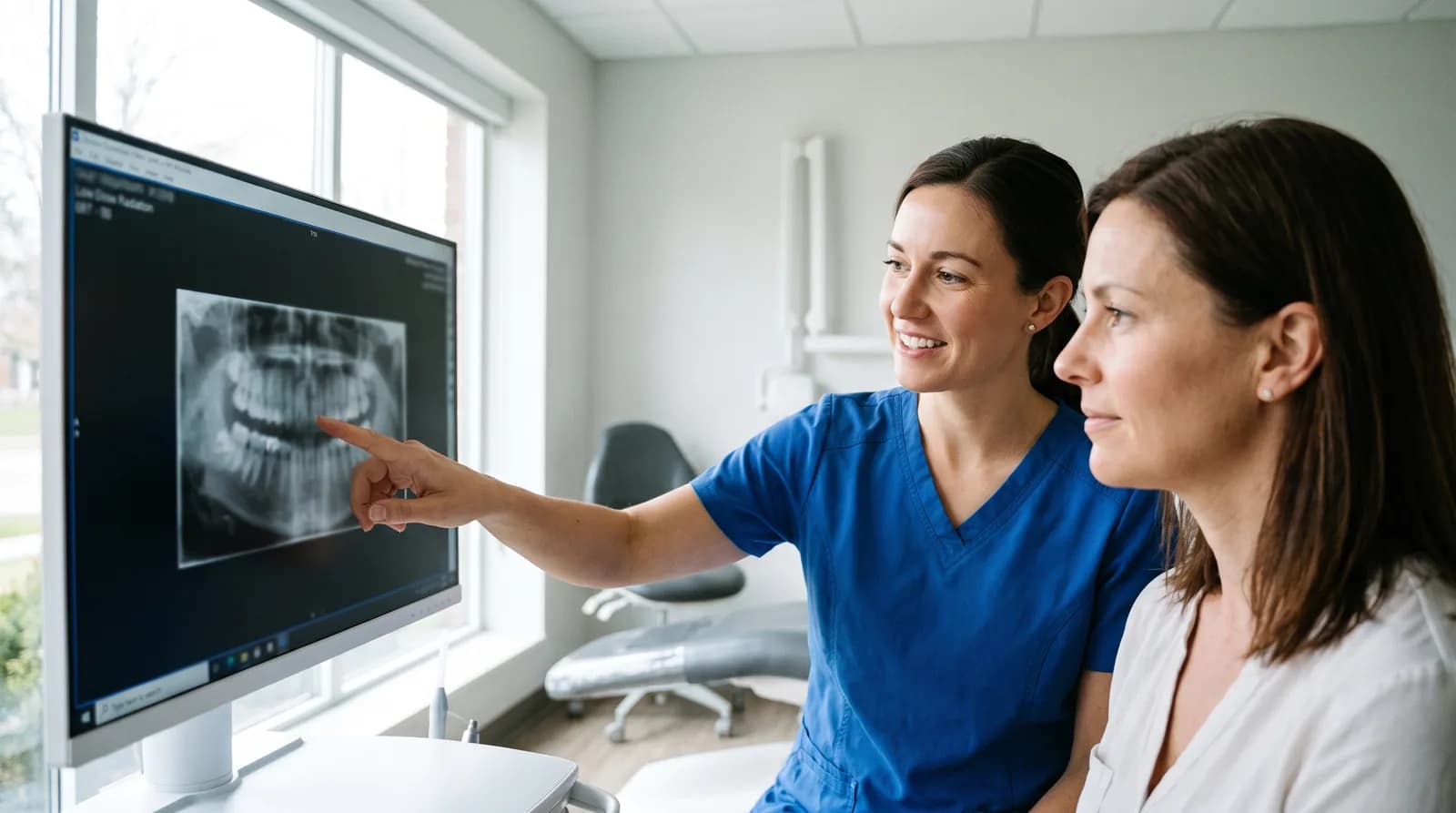
Dental X-Ray Safety: Radiation, Lead Aprons, and Pregnancy
Dr. Muhammad Rahim, DMDOctober 13, 202611 min read
Loading blog post
Dr. Muhammad Rahim, DMDOctober 13, 202611 min readCall and you'll reach a real person on our team: no phone tree, no hold music. We'd genuinely love to help.
(603) 924-3664Rather write to us? Contact us
Dental x-ray safety comes up at almost every new patient visit, and it's a fair question. Nobody wants radiation they don't need. The short version: a set of four bitewing X-rays with modern digital equipment delivers less radiation than you pick up from nature in a single day. At Peterborough Family Dental & Implant Center in Peterborough, NH, X-rays are one tool among many dental services we use to find problems early, and we only take them when they will change what we do next.
Below, you'll find real dose numbers, why the American Dental Association (ADA) stopped recommending lead aprons, how often X-rays actually make sense, and what changes for pregnancy and for kids.
Not sure if you're due for X-rays?
We review your history first and take images only when they will answer a real clinical question.
Request an Appointment →A routine set of four digital bitewings delivers roughly 5 microsieverts (µSv), which is less than one day of natural background radiation. A full-mouth series is higher, about 35 to 171 µSv depending on how tightly the beam is focused, but it's still a small dose and it's usually taken only every few years.
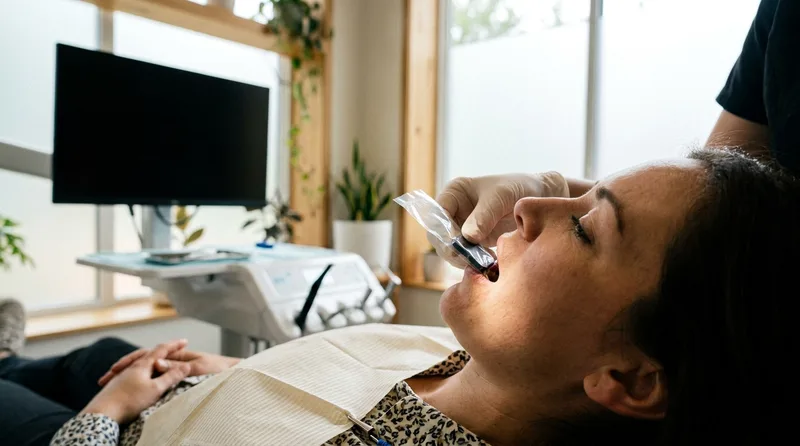
Those figures come from a widely cited 2008 study by Ludlow and colleagues in The Journal of the American Dental Association, which the ADA still references today. Doses vary with the machine, the sensor, and the technique. So treat the numbers below as typical ranges, not exact readings from any one office.
| Imaging type | Typical effective dose | About the same as |
|---|---|---|
| Four bitewings (digital, focused beam) | About 5 µSv | Less than 1 day of natural background radiation |
| Panoramic X-ray | About 14 to 24 µSv | 2 to 3 days of natural background radiation |
| Full-mouth series | About 35 to 171 µSv | Roughly 4 to 20 days of natural background radiation |
| 3D cone beam CT (CBCT) | Varies widely with scan size | Used only when a 2D image can't answer the question |
Notice the big spread on the full-mouth series. The low end reflects a beam shaped to the size of the sensor, a technique called rectangular collimation. The high end reflects the older round beam. Same diagnostic goal, very different dose. That gap is a big reason modern technique matters more than the X-ray itself.
Dental x-ray safety looks very different once you compare it with the radiation you get every day. Natural sources such as soil, radon, and cosmic rays give the average American about 3.1 millisieverts (mSv) a year, which works out to roughly 8.5 µSv per day before any medical imaging at all.
According to the National Council on Radiation Protection and Measurements, as summarized by the ADA, the average total dose in the U.S. is about 6.2 mSv a year. About 50% of that comes from nature. The other half comes mostly from medical imaging, and CT scans make up the largest share of that.
Dental imaging is a tiny slice of the picture. The ADA reports that dental X-rays account for less than 1% of the collective dose Americans receive from medical imaging. Put another way, a year of routine bitewings for a healthy adult is a rounding error next to a single chest CT.
That doesn't mean the dose is zero. Radiation effects add up over a lifetime, which is why dentists follow a principle called ALARA: as low as reasonably achievable. Every image should earn its place.
Yes, in most cases digital X-rays need less radiation than film to produce a usable image. Digital sensors respond to X-rays more efficiently, so the exposure can be shorter, and the ADA's expert panel lists digital receptors as one of its main steps for keeping patient doses low.
The size of the savings depends on the specific sensor and the film it replaced, so be wary of any single percentage you see quoted online. What's consistent is the direction: digital lowers the dose, and it removes the developing chemicals and silver waste that film required.
There's a practical benefit too. Digital images appear on the screen in seconds. Your dentist can zoom in on a shadow between two teeth, adjust the contrast, and show you exactly what they're seeing. Fewer unclear images also means fewer retakes, and a retake is extra radiation nobody needed.

At our Peterborough office, the team uses digital sensors for everyday X-rays and a Planmeca 3D scanner with an Ultra Low Dose setting for cases like implant planning. You can read more about the equipment on our dental technology page.
The ADA no longer recommends lead aprons or thyroid collars for dental X-rays because modern equipment already keeps scatter radiation extremely low. In 2024, an ADA expert panel concluded that shielding isn't needed for patients of any age or health status, and that it can actually block the image.
That last point surprises a lot of people. A collar that slips into the path of the beam hides part of the jaw. The result is a blurry or incomplete image, and that usually means taking the X-ray again. Two exposures where one would have done is the opposite of safer.
You can read the announcement in the ADA's 2024 radiography safety update. The panel pointed to three things that protect you far better than a lead apron:
One honest caveat. State radiation rules set their own requirements, and the ADA notes that dentists must follow them. If you'd still feel more comfortable with an apron, just say so. Your dental team can explain how they handle it and why.
Related: If bitewing sensors make you gag, there are simple tricks that help. How to stop gagging at the dentist →
There's no fixed schedule that fits everyone. The ADA says the right interval depends on your age, your current oral health, your risk for cavities and gum disease, and any symptoms, which is why one patient may need bitewings yearly while another goes several years between sets.
In 2026, the ADA and the American Academy of Oral and Maxillofacial Radiology published updated patient selection recommendations. They replaced the 2012 guidance and kept the same core idea: do a careful clinical exam first, then decide whether an image will change the diagnosis or the treatment plan.
Here's what usually points toward more frequent X-rays, and what points toward fewer:
Moving to a new dentist? Bring your recent X-rays, or ask your old office to send them. If the images are recent and clear, there may be no reason to retake them. Our first dental appointment checklist covers what else is worth bringing.
If you're ever unsure why an X-ray is being recommended, ask. The ADA encourages dentists and patients to make that call together, and a good answer should be specific: what the dentist is looking for and how the result would change your care.
Yes, dental X-rays are considered safe during pregnancy when your dentist needs them for diagnosis. The ADA notes that studies of pregnant patients support the safety of dental care, and the American College of Obstetricians and Gynecologists says necessary dental X-rays shouldn't be postponed because of pregnancy.
The dose from a dental X-ray is aimed at your mouth, far from the abdomen. And according to the ADA's MouthHealthy guide to X-rays, abdominal and thyroid shielding is no longer needed for any patient group, including people who are pregnant.
Untreated dental problems carry their own risks. An abscess or a spreading infection during pregnancy is a bigger concern than the tiny dose needed to diagnose it. That said, there's nothing wrong with waiting on routine, non-urgent images until after delivery if you and your dentist agree there's no pressing reason to take them now.
Always tell the team if you're pregnant or think you might be. It helps them plan the visit, choose the timing, and answer your questions with your situation in mind.
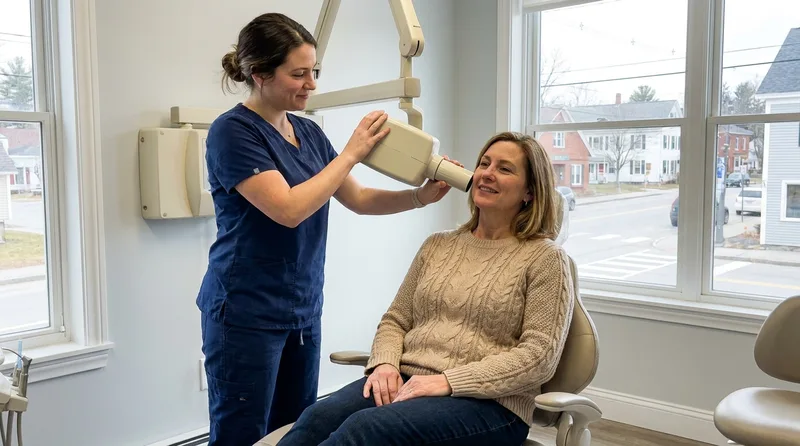
Children can safely have dental X-rays, but they should be taken only when needed and with settings sized for a child. Kids are more sensitive to radiation than adults, which is why the ADA joined more than 80 health organizations in the Image Gently campaign to "child-size" every exposure.
In practice, that means a shorter exposure time, the fastest receptor available, and a beam limited to the area of concern. It also means not taking X-rays on a fixed calendar. A child with no cavities and healthy habits may go a long time between bitewings, while a child with frequent decay may need them more often.
X-rays often matter most for kids in two situations: checking for cavities between back teeth that touch, and watching how adult teeth are developing under the baby teeth. Both are hard to see any other way.
Related: Wondering when your child should start regular visits? When should a child first see the dentist →
Our team follows the same steps the ADA recommends for limiting radiation, starting with the question of whether an X-ray is needed at all. When it is, digital sensors and careful positioning keep the dose low and help us get a clear image on the first try.
Here's how a typical decision works at your dental exam:
You can always ask why an image is being recommended. We'd rather explain it than have you leave with questions.
Questions about X-rays at your next visit?
Our team will walk you through what we recommend and why, before anything is taken.
Contact Our Office →For most people, yes. When an X-ray is clinically justified, the information it gives far outweighs the small dose, because it finds decay, infection, and bone loss while they're still small and simpler to treat. The key is that each image has a clear reason behind it.
Those problems are common, and many don't cause symptoms early. The CDC reports that about 1 in 5 adults aged 20 to 64 (21%) has at least one untreated cavity, and about 42% of adults aged 30 and older have some form of gum disease. Bone loss from gum disease is exactly the kind of change an X-ray shows before you can feel it.
Dental x-ray safety isn't about avoiding X-rays altogether. It's about the right image, at the right time, with modern equipment. If you're in the Peterborough or Monadnock area and want an honest answer about whether you're due, our team is happy to talk it through.
Results may vary. Please consult with your dentist at Peterborough Family Dental for personalized treatment recommendations.
Book your exam at Peterborough Family Dental
We take X-rays only when they'll help, and we'll always explain what we see.
Request an Appointment →Prefer to talk it through first? Call our Peterborough office at (603) 924-3664.
Call (603) 924-3664 →
Dr. Muhammad Rahim, DMD
Dentist · Peterborough Family Dental & Implant Center
Peterborough, NH dentist providing gentle general, cosmetic, restorative, and implant dentistry for the whole family.
Was this article helpful?
Yes. Digital sensors usually need less radiation than film to produce a clear image, and the ADA lists them as a dose-reduction step. They also show images in seconds, which cuts down on retakes. The exact savings depend on the equipment, so be cautious with single percentages quoted online.
Our Peterborough team is happy to answer questions and get you on the calendar.


