
Back to all articlesPediatric Dentistry Dr. Muhammad Rahim, DMDOctober 7, 202611 min read
When Should a Child First See the Dentist? What to Expect
Dr. Muhammad Rahim, DMDOctober 7, 202611 min read
Loading blog post
Dr. Muhammad Rahim, DMDOctober 7, 202611 min readCall and you'll reach a real person on our team: no phone tree, no hold music. We'd genuinely love to help.
(603) 924-3664Rather write to us? Contact us
When should a child first see the dentist? By the first birthday, or as soon as the first tooth appears, whichever comes first. That surprises a lot of parents, who picture the first visit happening around preschool. But a cavity can start the moment a tooth breaks through the gums.
The good news is that a baby's first visit is short and simple. There's no long cleaning and usually no X-rays. It's a friendly look at new teeth, a few minutes of coaching for you, and a chance for your child to meet the team. It's one of the dental services we're happiest to provide, because it sets up everything that follows.
This guide covers the right age, what happens during the visit, how to prepare your child, and what to do if they're nervous.
Ready to book your child's first visit?
Dr. Muhammad Rahim and Dr. Jasper Ainslie welcome babies, toddlers, and first-timers of any age at our Peterborough, NH office. Parents are always welcome in the room.
Request an Appointment →A child should first see the dentist when the first tooth appears and no later than the first birthday. The American Dental Association and the American Academy of Pediatric Dentistry both recommend this timing, because cavities can start as soon as teeth come in.
Our own rule of thumb is around the first birthday or within six months of the first tooth. Most babies get that first tooth around 6 months, so for many families the first visit lands somewhere between 6 and 12 months.
In practice, most kids start much later. A 2021 study in the Journal of the American Dental Association by McGivern and colleagues looked at insurance claims for 706,636 privately insured children up to age 6. The findings are worth a close look:
3.6 years
average age at a child's first dental exam
Source: JADA, 2021
2x
higher chance of needing fillings when the first visit was at age 3
Source: JADA, 2021
4x
higher chance of needing fillings when the first visit was at age 4
Source: JADA, 2021
Compared with kids who were seen earlier, children whose first exam came at age 3 had about twice the risk of needing restorative treatment, and those first seen at 4 had nearly four times the risk. A later start doesn't cause cavities, of course. But it does mean small problems have more time to grow before anyone spots them.
Already past the first birthday?
That's completely fine. Whether your child is two or six, the first visit looks much the same: friendly, unhurried, and paced to them. The best time to start is now.
A dental visit before age 1 matters because baby teeth can decay as soon as they appear, and early habits like bedtime bottles shape cavity risk long before preschool. An early visit catches problems while they're tiny and gives parents a clear plan for daily care at home.
It also gives your child a dental home: one office and one team that knows their history from the very start. That continuity pays off later, when a question comes up about a wiggly tooth, a fall at the playground, or a new habit you're not sure about.
Early visits are about prevention more than treatment. According to the CDC's National Health and Nutrition Examination Survey, 8.8% of children ages 2 to 5 already had at least one untreated cavity in 2015 to 2016. Many of those started as small spots that a quick look could have caught.
Myth
There's no point seeing a dentist until all the baby teeth are in, around age 3.
Fact
Cavities can form on the very first tooth. A visit by age 1 lets the dentist check new teeth, spot early decay, and coach you on brushing, bottles, and fluoride before habits set in.
The first visit is really the first step in a longer plan. Our parent's guide to dental care at every age shows how your child's needs change from baby teeth through the teen years.
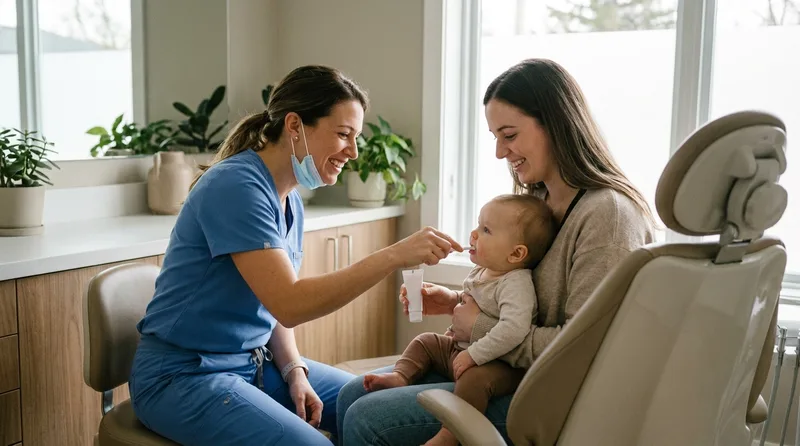
A child's first dental visit is a short, gentle exam, often done with your child sitting on your lap. The dentist counts teeth, checks the gums, jaw, and bite as they develop, cleans the teeth if your child is comfortable, and shares tips for brushing, feeding, and fluoride at home.

For babies and young toddlers, many dentists use a knee-to-knee position. You sit facing the dentist, your child lies back across both laps, and you stay in physical contact the whole time. Older toddlers may prefer the big chair with a parent close by.
Here's how the visit usually unfolds:
Fluoride usually comes up, because it strengthens young enamel and local water may or may not supply it. Our guide on fluoride and your child's teeth covers that in detail.
| Child's age at first visit | What the visit usually looks like |
|---|---|
| Under 2 | Lap or knee-to-knee exam, counting teeth, and parent coaching. Very short. |
| Ages 2 to 3 | Chair or lap exam, a gentle polish, and fluoride varnish if it's recommended. |
| Ages 4 and up | A full cleaning and exam, plus X-rays only if the dentist needs a closer look. |
Prepare your child by keeping the talk brief and positive, reading a picture book about the dentist, practicing opening wide at home, and booking a time when they're usually well rested. How you describe the visit shapes how your child walks in, so a calm, matter-of-fact tone helps most.
Kids take their cues from you. If the dentist sounds like a normal check, the same as a visit to the pediatrician, most children arrive curious instead of worried. A long, dramatic build-up tends to backfire.
A few days before the appointment:
| Try saying | Why it works |
|---|---|
| The dentist will count your teeth. | Simple, concrete, and easy for a toddler to picture. |
| They'll make sure your teeth are growing strong. | Frames the visit as a normal health check. |
| You can sit on my lap if you want. | Gives your child some control and comfort. |
| We'll go to the park afterward. | Gives them something fun to look forward to without bribing. |
Leave out words that hint at discomfort, even reassuring ones. A phrase meant to calm can plant a worry your child hadn't thought of yet.

Day-of checklist
Tick these off before you leave the house.
Several of these tips come straight from the ADA's MouthHealthy guide, which you can read in full on its page about your baby's first dental visit.
If your child is nervous or cries at the dentist, that's normal and nothing to worry about. Young children are often wary of new places and people. A good dental team goes slowly, explains each step first, and never forces a frightened child through a visit.
Share of children and teens with dental anxiety, by age group
Preschoolers 36.5%
School-age children 25.8%
Adolescents 13.3%
Source: Grisolia et al., International Journal of Paediatric Dentistry, 2021
Dental worries are most common in the youngest kids. A 2021 meta-analysis by Grisolia and colleagues pooled 50 studies and found dental anxiety in 36.5% of preschoolers, dropping to 13.3% in adolescents. That's another reason to start early: a calm first visit before age 1 comes before most fears have a chance to form.
Here's how we keep things easy for kids at our Peterborough office:
"The goal of the first appointment is a good memory, not a perfect checkup."
The Peterborough Family Dental team
A few tears don't mean the visit went badly. Stay calm, stay close, and let the team lead. In our experience, many of the most anxious young patients become the most enthusiastic ones after a few good visits.
Parents should ask about toothpaste amounts, fluoride, bottles and sippy cups, teething, and any habits like pacifiers or thumb sucking. It also helps to ask when to come back and what signs to watch for at home, so you leave with a clear plan for the next six months.
Good questions to bring:
If feeding has been a struggle, mention that too. Sometimes a tight band of tissue under the tongue plays a part. The dentist can take a quick look and, if needed, refer you to a provider who treats tongue tie in babies.
After the first visit, most children return every six months for a gentle checkup and cleaning. Those regular visits let the dentist follow new teeth as they arrive, catch small changes early, and keep each appointment short, easy, and familiar for your child.
Those six-month visits are where gentle checkups for kids come in: a careful exam, a soft polish, fluoride, and brushing coaching that actually sticks. Most take about half an hour.
Is it time to book?
Has your child's first tooth come in, or are they past their first birthday?
Yes: Book a first visit.
No ↓
Do you see a white or brown spot, or a chipped tooth?
Yes: Call us so we can take a look soon.
No ↓
Has it been more than six months since the last checkup?
Yes: Schedule a routine visit.
No ↓
None of these yet? Keep wiping gums and brushing, and plan the first visit for when that first tooth arrives.
Families come to us from Peterborough, Jaffrey, Dublin, Hancock, and across the Monadnock region. We accept most dental insurance, and parents and kids can book back-to-back visits with one familiar team.
The first visit is less about your child's teeth today and more about every visit after it. Start by age 1, keep it positive, and you'll give your child a head start on a lifetime of easy checkups.
Results may vary. Please consult with your dentist at Peterborough Family Dental for personalized treatment recommendations.
Book your child's first dental visit
Tell us a little about your child and we'll find a time that works for your family. Call (603) 924-3664 or request an appointment online.
Book Your Child's Visit →
Dr. Muhammad Rahim, DMD
Dentist · Peterborough Family Dental & Implant Center
Peterborough, NH dentist providing gentle general, cosmetic, restorative, and implant dentistry for the whole family.
Was this article helpful?
Book the visit around the first birthday anyway. Some babies get teeth later than others, which is usually normal. The dentist can check the gums and jaw, confirm teeth are developing under the gums, and give you tips so you're ready when they arrive.
Our Peterborough team is happy to answer questions and get you on the calendar.


