
Back to all articlesRestorative Dentistry Dr. Muhammad Rahim, DMDOctober 12, 20269 min read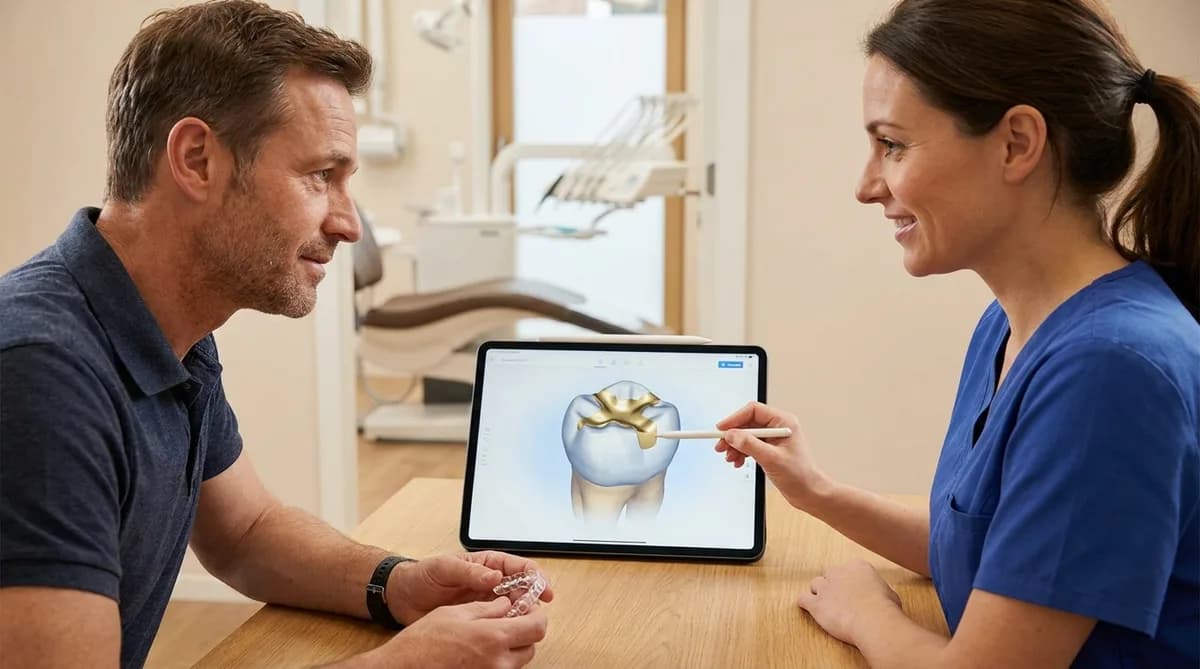
Inlays and Onlays vs Fillings and Crowns: Which Fits?
Dr. Muhammad Rahim, DMDOctober 12, 20269 min read
Loading blog post
Dr. Muhammad Rahim, DMDOctober 12, 20269 min readCall and you'll reach a real person on our team: no phone tree, no hold music. We'd genuinely love to help.
(603) 924-3664Rather write to us? Contact us
Some teeth have more damage than a filling can reliably fix, but not enough to need a full crown. Inlays and onlays sit right in that gap: lab-made pieces bonded into a back tooth that last longer than a big filling and save more tooth than a crown. Most patients have never heard of them.
They're custom-made restorations that fit inside or over the damaged part of a tooth. Sometimes called indirect fillings, they're one of the more conservative dental services in restorative care, because they keep more of your natural tooth.
At Peterborough Family Dental, Dr. Muhammad Rahim, DMD, uses inlays and onlays to preserve as much healthy tooth as possible. This guide compares them with fillings and crowns, explains who they suit, and walks through the process.
Inlays and onlays are custom-made dental restorations fabricated outside the mouth and bonded onto a tooth to repair moderate damage. An inlay fills the inside of the chewing surface; an onlay extends over one or more cusps. Both preserve more tooth than a crown while providing more durability and precision than a standard filling.
Both are made outside the mouth, in a lab or with CAD/CAM milling, then bonded to the prepared tooth. That's the source of their strength. The material is fully hardened and finished under ideal conditions, so it ends up denser and more stable than a filling that sets inside your mouth.
Common materials include porcelain, gold, and composite resin. Porcelain and tooth-colored composite are the most popular for aesthetic reasons, since they closely match natural tooth color. Gold is the most durable and is sometimes preferred for back teeth where esthetics matter less than longevity.
Each material trades looks against strength a little differently. Here's how they stack up:
| Material | Looks | Strength | Best for |
|---|---|---|---|
| Porcelain / ceramic | Matches tooth color closely | Strong, can chip with heavy grinding | Visible back teeth |
| Gold | Clearly metallic | The most durable option | Back molars out of sight |
| Composite resin | Tooth-colored | Less wear-resistant than ceramic | Smaller restorations, tighter budgets |
Most patients choose porcelain because it blends in. Gold still earns its place on a back molar for anyone who cares more about longevity than looks, and it's gentle on the opposing teeth. Your dentist will recommend a material based on where the tooth sits and how hard you bite.
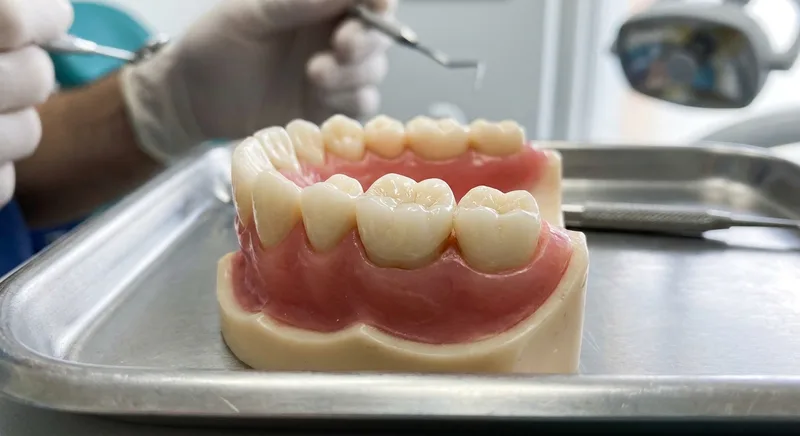
The difference comes down to how they're made. A filling goes into the tooth soft and hardens there. An inlay or onlay is shaped as a solid piece first, then bonded in. The result is a better fit, a stronger restoration, and less shrinkage over time.
Direct composite fillings shrink slightly as they harden. That can leave tiny gaps at the edges where bacteria get in. An indirect restoration is finished before it's placed, so it doesn't have that problem.
Durability follows. A large composite filling on a back tooth may need replacing in five to ten years. A well-made ceramic or gold inlay can last two to three decades with good care, which matters a lot on a molar that takes heavy chewing every day.
They keep far more natural tooth than a crown. A crown needs the outer layer trimmed all the way around so it can sit over the tooth. An inlay or onlay removes only the damaged material and a small margin, leaving the rest of the healthy tooth alone.
The ADA's guide to crowns recommends a crown when a tooth is badly broken down, after a root canal, or when too little structure remains for anything else. When enough healthy tooth is left, a full crown would be overkill.
That's the trade-off. For comparison, a 2015 systematic review in Dental Materials found five-year survival above 90% for both all-ceramic and metal-ceramic single crowns, so a crown is a reliable fallback when partial coverage won't hold. A tooth cracked across several cusps, weakened by a root canal, or badly broken down is usually better off with a crown. The call depends on how much healthy tooth remains and what forces it has to handle.
| Restoration | How Much Tooth It Covers | Typical Use |
|---|---|---|
| Filling | Small area inside the cusps | Modest decay or a small fracture |
| Inlay | Between the cusps, made in a lab | Damage too wide for a filling |
| Onlay | One or more cusps as well | Damage that undermines a cusp |
| Crown | The whole visible tooth | Extensive damage or after root canal |
Related: Leaning toward a crown instead? Here's how the different crown materials compare. Types of dental crowns →
A good candidate has a back tooth with moderate to large damage, but enough healthy structure left that a crown would remove more than necessary. The most common case is a molar or premolar with a large cavity, a broken cusp, or an old filling that's starting to fail.
You may be a candidate if
People who grind their teeth may do better with a crown in some cases, since full coverage spreads those forces more evenly. That's one of the judgment calls Dr. Rahim makes at the exam. Not every large cavity needs an inlay, and not every inlay candidate would be better off with a filling.
1 in 4
U.S. adults has untreated tooth decay, which often turns a small repair into a bigger one
Source: CDC NCHS
By the time decay is treated, the choice is often between a large filling and a crown. Regular dental visits catch roughly 80% of oral health issues before they become serious, according to the ADA. Catching decay early is what keeps a tooth in inlay territory instead of crown territory.
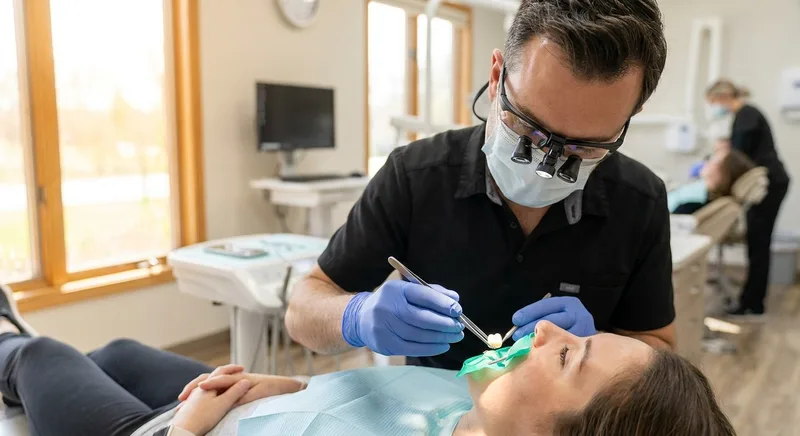
The procedure usually takes two appointments: one to prepare the tooth and take a digital scan, and a second to bond the finished restoration in place. At Peterborough Family Dental, chairside milling can sometimes bring that down to a single visit.
Most patients say the finished restoration feels natural almost right away. Sensitivity afterward is usually milder than after a crown preparation, because less tooth is removed.
Caring for the restoration means the same routine as natural teeth: brushing twice a day, flossing, and regular checkups so the edges can be monitored. The bonded edges are where wear shows up first, and catching it early keeps repairs simple.
The National Institute of Dental and Craniofacial Research notes that fluoride and good daily hygiene are the main defenses against new decay, and that applies to the edges of a restoration too. The inlay itself can't decay, but the tooth around it can.
⚠ Book a check if you notice
If you grind your teeth, ask about a night guard. Grinding can chip a ceramic inlay over time. With good home care and regular checkups, a well-placed ceramic or gold inlay often lasts 15 to 30 years.

These restorations usually cost more than a filling and about the same as, or a little less than, a crown. The price depends on the material, the size of the restoration, and whether the tooth needs other work first. Gold and ceramic generally cost more than composite.
The upfront number only tells half the story, though. A large filling that fails in seven years gets replaced, sometimes more than once, and each replacement removes a little more tooth. A restoration that lasts two decades often costs less over time, and it keeps the tooth strong enough to avoid a crown later.
Insurance usually treats these as major restorative work, similar to crowns. Many plans cover part of the cost when the restoration is needed to repair damage. The team can check your benefits and give you a written estimate before anything starts.
Keeping up with checkups also protects the investment. Americans who visit a dentist regularly are 60% less likely to lose teeth, according to the Journal of Dental Research, and that steady monitoring is what catches a worn edge before it turns into a bigger repair.
They're the right choice when damage is too extensive for a reliable filling, but the tooth is healthy enough that a crown would remove more than it needs to. They combine lab-made precision with a conservative, tooth-saving approach.
The decision ultimately rests on a proper clinical assessment. There is no way to determine candidacy from symptoms alone, because the size of the damage, the condition of the surrounding tooth, and the forces the tooth will bear all factor into the recommendation. At Peterborough Family Dental, Dr. Rahim explains the options clearly so patients can understand why a particular restoration is recommended and what to expect from it.
If an old filling has been giving you trouble, or a molar has been flagged at past visits, a restorative consultation is a good next step. The office is at 21 Grove Street in Peterborough, NH. Call (603) 924-3664 or use our contact page.
Keep reading
Results may vary. Please consult with your dentist at Peterborough Family Dental for personalized treatment recommendations.
Has a filling been flagged for replacement?
Book a restorative consultation at Peterborough Family Dental to find out whether an inlay, onlay, or another option fits your tooth.
Request an Appointment →
Dr. Muhammad Rahim, DMD
Dentist · Peterborough Family Dental & Implant Center
Peterborough, NH dentist providing gentle general, cosmetic, restorative, and implant dentistry for the whole family.
Was this article helpful?
An inlay fits within the central portion of the tooth's chewing surface, between the cusps. An onlay covers one or more of the outer cusps and extends over a larger area of the tooth. Both are custom-made and bonded in place, with an onlay being a more substantial restoration than an inlay.
Our Peterborough team is happy to answer questions and get you on the calendar.


