Early Orthodontic Treatment Age 7: What Parents Should Know
Dr. Muhammad Rahim, DMDOctober 7, 20269 min read
Early orthodontic treatment age 7 advice often confuses parents, because it sounds like a seven-year-old needs braces. Usually, they don't. The American Association of Orthodontists (AAO) recommends a first orthodontic check-up no later than age 7, and for most kids that visit is about watching, not treating.
This guide explains why age 7 matters, what the check looks at, which bite problems can benefit from early treatment, and when it's better to wait. You can also browse all of our dental services for the rest of your family.
Is your child around age 7?
Dr. Muhammad Rahim and Dr. Jasper Ainslie offer a complimentary orthodontic assessment in Peterborough, NH. We'll check the bite and jaw growth and tell you honestly whether anything needs attention.
Why Is Age 7 the Right Time for an Orthodontic Check?
Age 7 is a good time because most children have a mix of baby and permanent teeth by then. The first permanent molars and front teeth are in, so a dentist can see how the bite is forming and spot early jaw or spacing problems while there's still plenty of growth left to work with.
According to the AAO, a check-up at this stage gives a wealth of information as permanent teeth replace baby teeth and the face and jaws grow. The AAO also points out that a check-up isn't the same as starting treatment, and only a few problems need correction around age 7.
Tooth milestones timeline
Ages 6 to 7
First permanent molars and lower front teeth arrive, according to the ADA's tooth chart.
Age 7
The AAO recommends a first orthodontic check-up no later than this age.
Dentist · Peterborough Family Dental & Implant Center
Peterborough, NH dentist providing gentle general, cosmetic, restorative, and implant dentistry for the whole family.
Was this article helpful?
Frequently asked questions
It depends on your plan. Many dental plans include an orthodontic benefit, often with a lifetime maximum, and some cover early phases while others don't. We'll check your specific benefit at the free assessment and apply it to any treatment we recommend.
Most early treatment phases are measured in months rather than years. The exact length depends on the problem, the appliance, and how your child's teeth and jaws respond. Your dentist will give you an estimated timeline before treatment starts and update it as things progress.
Yes. The AAO says there's no need to wait until 7 if something looks off, such as a crossbite, an underbite, or teeth that don't meet. An earlier check can confirm whether anything needs attention or simply set your mind at ease.
Not always. Early treatment usually targets one specific problem, like a crossbite. Many children still benefit from braces or aligners once their adult teeth are in, though the second phase may be shorter or simpler as a result.
Not necessarily. Baby teeth are often spaced or slightly crooked, and adult teeth may come in differently. What matters more is how the jaws and bite develop, which is exactly what an orthodontic check at around age 7 is designed to assess.
Mild crowding is often best watched until more adult teeth arrive, leading to one efficient course of treatment.
Upper front teeth and lateral incisors come in, so spacing becomes easier to judge.
Ages 8 to 14
The ADA notes that orthodontic treatment often begins somewhere in this range.
Ages 10 to 13
Premolars, canines, and second molars arrive, completing most of the adult bite.
The ADA adds that bite problems usually become noticeable between ages 6 and 12. You can read its overview of braces and orthodontic treatment for more background.
What Does an Early Orthodontic Check Look At?
An early orthodontic check looks at how the upper and lower teeth meet, how the jaws are growing, whether there's enough room for the adult teeth, and whether habits like thumb sucking are shaping the bite. It's usually a quick exam, sometimes with photos or an X-ray.
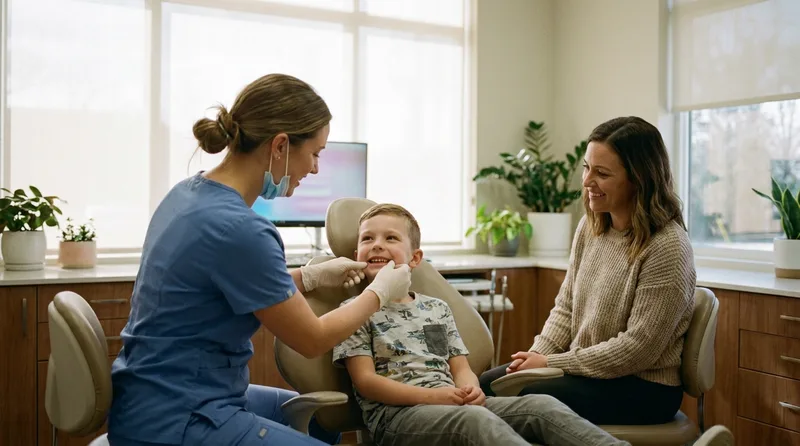
An early check looks at how the teeth meet and how the jaws are growing.
The AAO lists several problems worth catching early:
Crossbite: upper teeth sitting inside the lower teeth, in front or in back.
Crowding or spacing: too little or too much room for adult teeth.
Open bite: front teeth that don't meet when the back teeth close.
Deep bite or protrusion: upper front teeth that overlap a lot or stick out.
Underbite: lower teeth sitting in front of the upper teeth.
The AAO suggests checking in if you notice any of these.
Is Early Orthodontic Treatment Age 7 Always Needed?
No. Most children seen at age 7 don't need treatment yet. The AAO does not advocate full orthodontic treatment at this age, and many kids simply get monitored at regular checkups. Early, or interceptive, treatment is reserved for specific problems that are easier to fix while a child is still growing.
A check-up usually ends in one of three ways:
Everything looks on track. No action needed, just routine checkups.
Something to watch. A developing issue is noted and rechecked as more adult teeth come in.
Early treatment recommended. A specific problem would benefit from a short phase of treatment now.
Myth
An orthodontic check at age 7 means my child will get braces right away.
Fact
Most children seen at 7 are simply monitored. The check helps time treatment well, which for many kids means braces in the preteen or teen years, if at all.
Problem
Often treated early?
Why
Back-tooth crossbite
Often
Expanding the upper jaw works well while it's still growing
Front-tooth crossbite
Often
Can wear the teeth and affect how the jaw grows
Prominent upper front teeth
Sometimes
Mainly to lower the risk of injury to the teeth
Mild crowding
Usually not
Often watched until more adult teeth come in
Thumb-sucking habit
Depends
Habit help first; appliances only if it continues
Which Bite Problems Benefit Most From Early Treatment?
The strongest evidence for early treatment is for back-tooth crossbites and for reducing injuries to prominent upper front teeth. For children ages 7 to 11, Cochrane reviews found expansion appliances correct posterior crossbites far better than simply waiting, and early treatment cut front-tooth injuries.
Crossbites are fairly common. A 2021 Cochrane Review by Ugolini and colleagues reported posterior crossbite in about 4% of children and teens in Europe and 17% in America. In children ages 7 to 11, appliances like a quad-helix or an expansion plate corrected the crossbite much more often than observation alone, with high-certainty evidence.
Children with new front-tooth injuries, prominent upper teeth
Treated later, in adolescence30%
Treated early, ages 7 to 1119%
Source: Batista et al., Cochrane Database of Systematic Reviews, 2018
For prominent upper front teeth, the 2018 Cochrane Review by Batista and colleagues found that early treatment with a functional appliance lowered new front-tooth injuries to 19%, compared with 30% when treatment waited until adolescence. The authors found no other clear advantage of starting early for this problem.
Age 7
when the AAO recommends a first orthodontic check-up
Source: AAO
17%
of US children and teens have a back-tooth crossbite
Source: Cochrane Review, 2021
19% vs 30%
new front-tooth injuries with early vs later treatment
Source: Cochrane Review, 2018
What Does Early Orthodontic Treatment Involve?
Early treatment is usually a short, targeted phase that lasts months rather than years. It might be an appliance that gently widens the upper jaw, a functional appliance that guides growth, a habit appliance, or limited braces on a few teeth. Many children still need a second phase later.
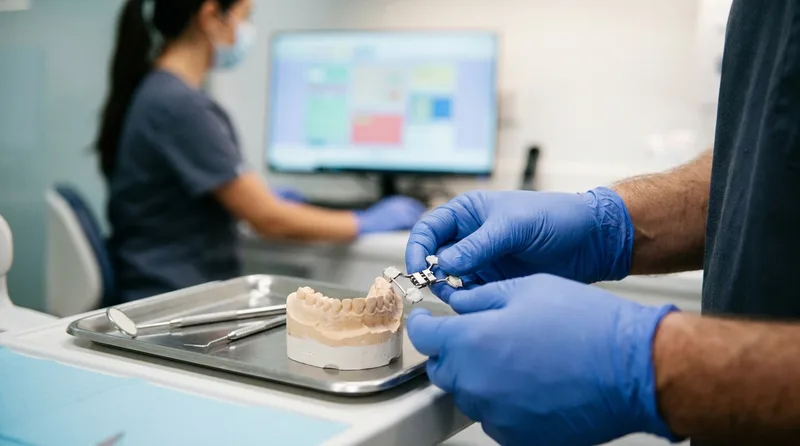
An expander gently widens the upper jaw to correct a back-tooth crossbite.
Common early treatment tools include:
Appliance
What it does
Palatal expander or quad-helix
Gently widens the upper jaw to correct a back-tooth crossbite
Functional appliance
Guides jaw growth and reduces protruding upper front teeth
Habit appliance
Makes thumb or finger sucking harder and less satisfying
Limited braces
Moves a few teeth, such as one stuck in a front crossbite
Space maintainer
Holds a gap open after a baby tooth is lost early
That second phase is worth knowing about up front. Early treatment often fixes one specific problem, and a full set of braces or aligners may still be recommended once the adult teeth are in.
Holding space for a lost tooth is a related but simpler issue. If your child lost a baby tooth early, our guide to space maintainers explains how that gap is protected until the adult tooth arrives.
Good to know
According to the ADA, bite problems can be inherited or result from injury, early or late tooth loss, or thumb sucking. Your dentist will look at all of these when deciding whether to treat now or wait.
Should You Wait Until All Adult Teeth Are In?
For many children, yes. If the check shows only mild crowding or spacing, waiting until more adult teeth arrive often leads to one efficient course of treatment instead of two. Waiting is the wrong choice mainly for crossbites, habits, or protruding teeth at high risk of injury.
Treat now or wait?
Is there a back-tooth or front-tooth crossbite?
Yes: Ask about early treatment, since the jaw responds best while growing.
No ↓
Do the upper front teeth stick out enough to be at risk in falls or sports?
Yes: Early treatment may lower the chance of injury.
No ↓
Is a thumb or pacifier habit still going strong?
Yes: Start with habit help, and ask whether an appliance makes sense.
No ↓
None of these? Monitoring at regular checkups is usually the right call.
Mouthguards matter for kids with prominent front teeth too, especially in contact sports, since protruding teeth are easier to injure.
Waiting doesn't mean doing nothing. Your child's bite gets rechecked at every six-month visit, so if something changes, such as a new crossbite or a tooth coming in out of position, we can adjust the plan right away instead of finding out years later.
What Happens at Your Child's Orthodontic Assessment?
An orthodontic assessment is a relaxed visit where the dentist examines your child's teeth, bite, and jaws, takes any photos or X-rays needed, and then walks you through what they see. At our office, the first orthodontic consultation is complimentary, with no obligation to start treatment.
A conversation first. We ask about chewing, breathing, habits, and anything you've noticed at home.
A bite and jaw exam. We look at how the teeth meet and how the jaws line up and move.
Photos or X-rays if needed to see the adult teeth still developing under the gums.
A plain-language summary. You'll hear whether to treat now, watch, or simply relax.
A written plan if treatment makes sense, including timing and insurance estimates.
Bring any questions you have, and let your child know it's just a look, nothing more. Most kids find it easier than a cleaning. If your child is older than 7, that's fine too. The AAO notes it's not too late for a check-up, and most bite problems can still be treated successfully as kids grow.
How Do We Handle Orthodontic Checks at Peterborough Family Dental?
We check every child's bite and jaw growth at regular visits, and we offer a complimentary orthodontic assessment when a closer look makes sense. If treatment is needed, our own team can plan and monitor it in-house. If waiting is better, we'll tell you that and simply keep watching.
You'll leave knowing whether to treat now, watch, or simply relax.
Our braces and orthodontic care covers kids, teens, and adults, with metal, ceramic, and self-ligating braces, clear aligners for suitable cases, and retainers to keep results in place. You'll see the same familiar team at every visit.
The age 7 check isn't about rushing into treatment. It's about knowing early, so you can act at the right moment, or relax knowing everything is on track.
Results may vary. Please consult with your dentist at Peterborough Family Dental for personalized treatment recommendations.
Book your child's orthodontic check
Ask about our complimentary orthodontic assessment, and we'll tell you honestly whether to treat, watch, or relax. Call (603) 924-3664 or request a visit online.


 Dr. Muhammad Rahim, DMDOctober 7, 20269 min read