
Back to all articlesOral Health Tips Dr. Muhammad Rahim, DMDOctober 11, 20269 min read
Can a Dentist Detect Sleep Apnea? Signs They Look For
Dr. Muhammad Rahim, DMDOctober 11, 20269 min read
Loading blog post
Dr. Muhammad Rahim, DMDOctober 11, 20269 min readCall and you'll reach a real person on our team: no phone tree, no hold music. We'd genuinely love to help.
(603) 924-3664Rather write to us? Contact us
Can a dentist detect sleep apnea? A dentist can't diagnose it, but they're often the first to spot the warning signs. Worn or cracked teeth from grinding, a scalloped tongue, a narrow airway, and large tonsils can all point to disrupted breathing at night. When those signs show up, your dentist can refer you for a sleep study.
This guide explains what dentists look for, how grinding and sleep apnea are linked, who's most at risk, and what happens after a dentist raises the question. You can also browse all of our dental services to see the care we offer.
Snoring, grinding, or waking up tired?
Mention it at your next checkup. Dr. Muhammad Rahim and Dr. Jasper Ainslie can look for the dental signs and help you take the next step with your physician.
Request an Appointment →A dentist can spot signs that suggest sleep apnea, but only a physician can diagnose it, usually with a sleep study. Because you see your dentist every six months, they're well placed to notice changes in your teeth, jaw, tongue, and throat that hint at breathing problems during sleep, then point you toward testing.
Obstructive sleep apnea happens when the soft tissue at the back of the throat collapses during sleep and blocks airflow, according to the ADA. Each pause pulls you out of deep sleep, often without you remembering it. Over time, untreated sleep apnea is linked to high blood pressure, stroke, heart problems, diabetes, and depression.
It's also far more common than most people realize. Using Wisconsin Sleep Cohort data, a 2013 study in the American Journal of Epidemiology estimated moderate to severe sleep apnea in 10% of men ages 30 to 49 and 17% of men ages 50 to 70.
17%
of men ages 50 to 70
Am J Epidemiol, 2013
10%
of men ages 30 to 49
Am J Epidemiol, 2013
9%
of women ages 50 to 70
Am J Epidemiol, 2013
3%
of women ages 30 to 49
Am J Epidemiol, 2013
Those figures are for moderate to severe sleep apnea alone, so milder cases add even more. Many people with it have never been tested.
Dentists may notice worn, flattened, or cracked teeth from grinding, a scalloped tongue with tooth marks along its edges, a large tongue or tonsils, a narrow or crowded upper jaw, a small or set-back lower jaw, and redness at the back of the throat. None proves sleep apnea alone, but together they raise the question.
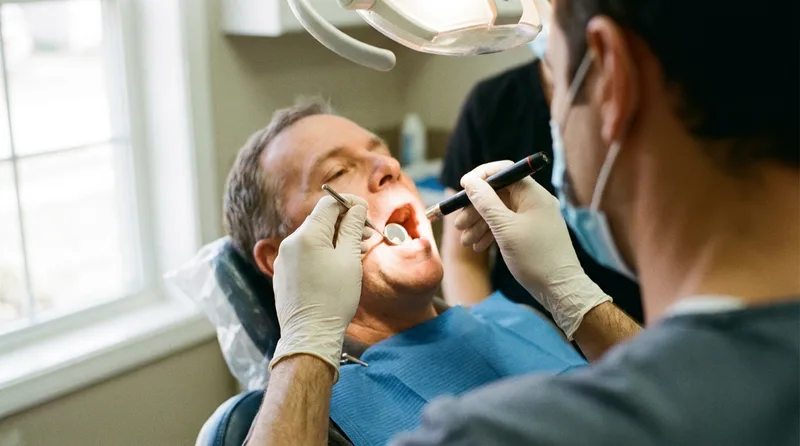
Here's what your dentist may be looking at during a routine exam:
Your dentist will also ask questions. Do you snore? Wake up with headaches or a sore jaw? Feel exhausted even after a full night? Has a partner noticed you stop breathing? Your answers matter as much as what's visible.
The ADA notes that the risk is greater for people with a large tongue, large tonsils, or a small jaw, which are exactly the features a dentist sees up close at every visit.
Teeth grinding and sleep apnea often show up together. A 2026 umbrella review in Sleep Medicine looked at eight systematic reviews and found adults with obstructive sleep apnea appear more likely to grind their teeth at night. The authors said the link may run both ways, but the evidence quality was mostly low.
One theory is that grinding happens during the brief micro-arousals that follow breathing pauses, as the body briefly wakes to reopen the airway. You can read the abstract of the 2026 umbrella review on sleep apnea and grinding on PubMed. The review screened 1,726 records before narrowing to the eight reviews it analyzed.
The practical takeaway is simple. If you grind your teeth, it's worth asking whether your sleep is disrupted too. Plenty of people grind without having sleep apnea, often from stress, but the two overlap often enough that a dentist will want to rule it out.
This also matters for treatment. A standard night guard protects teeth from grinding, but it doesn't open the airway. If sleep apnea is part of the picture, a different type of appliance, or a different treatment altogether, may be the better choice.
| Feature | Night guard | Sleep apnea appliance |
|---|---|---|
| Main job | Protects teeth from grinding | Helps keep the airway open |
| How it works | Cushions the biting surfaces | Holds the lower jaw slightly forward |
| Needs a diagnosis first | No | Yes, from a physician |
| Follow-up | Routine dental checks | Dental and physician follow-up |
Using a night guard when sleep apnea is the real problem can give a false sense of security. That's why your dentist may ask about snoring and fatigue before recommending one, especially if you grind heavily.
Sleep apnea can affect anyone, but the ADA says risk is higher for people over 40, those who are overweight, people with large tonsils, a large tongue, or a small jaw, those with a family history of sleep apnea, and people with nasal blockage from a deviated septum, allergies, or sinus problems. Men are more likely to develop it.
Use this quick list as a starting point. Tick any that apply:
Sleep apnea warning signs
Check any that apply to you.
Two or more checks is a good reason to talk with your dentist or physician.
Women's risk rises after menopause, which is reflected in the 2013 study's estimates jumping from 3% at ages 30 to 49 to 9% at ages 50 to 70. Children can have sleep apnea too, often linked to enlarged tonsils or adenoids.
Weight plays a strong role as well. The authors of the 2013 study noted that obesity is a strong cause of sleep-disordered breathing, and their estimates rose by 14% to 55% over two decades depending on the group, alongside rising obesity rates. A checklist can't diagnose anything. But it can help you decide when to bring it up, and it gives your dentist and physician useful information to start with.
If your dentist suspects sleep apnea, they'll share what they noticed and suggest you see your physician or a sleep specialist. A sleep study, done at home or in a sleep lab, confirms whether you have it and how severe it is. Treatment decisions come after that diagnosis.
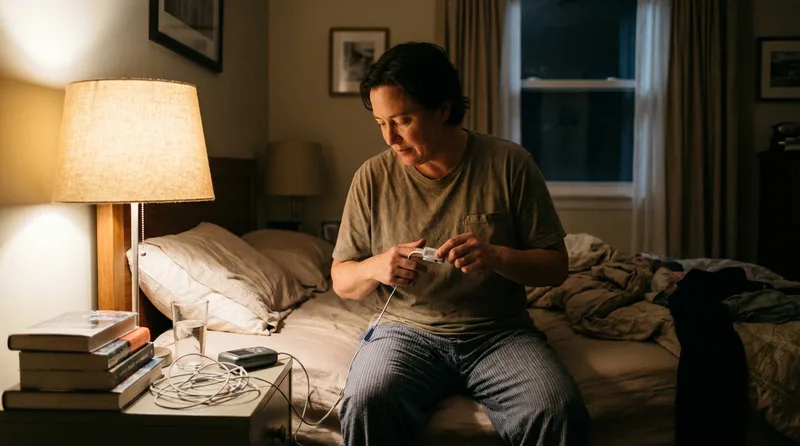
The usual path looks like this:
The ADA lists several treatment options, including adjusting sleep position, CPAP, oral appliances, and surgery in some cases. Which one fits depends on your diagnosis.
A 2015 clinical practice guideline from the American Academy of Sleep Medicine and the American Academy of Dental Sleep Medicine recommends that sleep physicians consider oral appliances for adults who can't tolerate CPAP or prefer another option. It also recommends ongoing dental follow-up once an appliance is in use.
The team-up matters because each sees part of the picture. Your dentist sees the mouth, jaw, and airway regularly, while your physician diagnoses sleep apnea and manages its effects on the rest of your body. Working together, they can catch it earlier and choose a treatment you'll actually stick with.
Many people see their dentist more often than their doctor. That makes the dental chair a natural place to raise a concern that might otherwise go unnoticed for years.
It also helps after treatment begins. If you're prescribed an oral appliance, your dentist checks the fit, your bite, and your jaw comfort over time, while your physician confirms that your sleep and breathing have actually improved. The 2015 guideline specifically recommends this kind of shared follow-up.
And sleep apnea affects your oral health too. Mouth breathing dries the mouth, which can raise cavity and gum disease risk, and grinding wears down teeth and restorations. Treating the sleep problem can protect your smile as well as your heart.
If you already have a sleep apnea diagnosis, let your dentist know even if you use CPAP. Mask pressure, dry mouth, and jaw position can all affect your teeth and gums, and your dentist can help you manage those side effects while your physician manages the sleep apnea itself.
We look for the dental signs of sleep apnea at routine checkups, ask about snoring and sleep, and talk openly with you if something stands out. If a sleep study confirms sleep apnea, we can make a custom oral appliance as part of the plan your physician recommends.

Our sleep apnea and snoring appliances are custom-fitted, FDA-cleared devices worn only while you sleep, with no mask or hose. We offer free sleep consultations, and many medical plans help cover them.
Want to know how the appliance itself works? Our guide to oral appliance therapy for sleep apnea walks through candidacy, the fitting process, and how it compares to CPAP.
So, can a dentist detect sleep apnea? Not on their own, but they're often the first to notice the clues. If you snore, grind, or wake up exhausted, bring it up at your next visit.
Results may vary. Please consult with your dentist at Peterborough Family Dental for personalized treatment recommendations.
Sleep better, starting with a conversation
Book a free sleep consultation or mention your symptoms at your next checkup. Call (603) 924-3664 or request a visit online.
Request an Appointment →
Dr. Muhammad Rahim, DMD
Dentist · Peterborough Family Dental & Implant Center
Peterborough, NH dentist providing gentle general, cosmetic, restorative, and implant dentistry for the whole family.
Was this article helpful?
A dentist can notice signs during a regular exam, such as worn teeth, a scalloped tongue, or a narrow airway, and ask about snoring and fatigue. They can't diagnose sleep apnea, but they can recommend you see your physician for a sleep study.
Our Peterborough team is happy to answer questions and get you on the calendar.


