
Back to all articlesDental Implants Dr. Muhammad Rahim, DMDOctober 6, 202610 min read
How Long Do Dental Implants Last? Lifespan and Care Tips
Dr. Muhammad Rahim, DMDOctober 6, 202610 min read
Loading blog post
Dr. Muhammad Rahim, DMDOctober 6, 202610 min readCall and you'll reach a real person on our team: no phone tree, no hold music. We'd genuinely love to help.
(603) 924-3664Rather write to us? Contact us
How long do dental implants last? With good care, the implant itself can last decades and often a lifetime. The crown on top usually needs replacing sooner, commonly after 10 to 15 years or more, because it takes the daily wear of chewing.
If you're weighing implants, that's probably the question behind all the others. Implants cost more upfront than other options, so you want to know the investment will hold up. The research is reassuring, and the parts that do wear out are usually simple to refresh. At Peterborough Family Dental & Implant Center, we talk through longevity at every consultation for dental implant treatment, because it shapes whether implants are the right fit for you.
Here's what the long-term studies show, which parts last longest, what shortens or extends an implant's life, how to care for it, and what our written warranty covers.
Implant lifespan at a glance
Implant post
Often a lifetime once fused with the jawbone
Crown
Commonly 10-15 years or more before wear needs attention
10-year survival
About 96% in a large 2019 review
Biggest factor you control
Daily cleaning and regular checkups
Considering implants and want them to last?
Book a consultation in Peterborough, NH. We'll look at your bone, gums, and bite, and explain what affects how long implants would last for you.
Request an Appointment →Dental implants commonly last for decades, and many last a lifetime. Large studies report that about 95% of implants are still in place and working after 10 years. The post fused to your jawbone is the long-lasting part, while the crown on top may be replaced once or twice over the years.

The reason is how an implant works. The titanium post bonds directly with the jawbone in a process called osseointegration. Once that bond forms, the post becomes part of your jaw, and it rarely needs replacing.
The crown is different. It takes every bite, every chew, and the occasional clench. Like a crown on a natural tooth, it can wear, chip, or loosen over time. That's normal, and replacing it doesn't disturb the implant underneath.
The short version
When people say an implant lasts a lifetime, they mean the post in the bone. Plan on the crown being the part that may need a refresh someday.
Long-term studies consistently show high implant survival. A 2019 review in the Journal of Dentistry estimated 96.4% survival at 10 years, and a 2015 review of studies with at least 10 years of follow-up reported 94.6%. Success rates over a decade are typically reported between 95% and 98%.
96.4%
10-year implant survival in a large meta-analysis
Source: Journal of Dentistry, 2019
94.6%
survival in studies with 10+ years of follow-up
Source: Int. J. Oral & Maxillofacial Surgery, 2015
95-98%
implant success rate over 10 years
Source: J. of Oral and Maxillofacial Surgery
The 2019 meta-analysis of 10-year implant survival pooled long-term data and found that the large majority of implants were still functioning a decade later. It also noted that results varied with patient factors, which is a reminder that the averages aren't destiny in either direction.
One nuance worth knowing: “survival” means the implant is still in place, while “success” also means it's free of significant problems. Most implants clear both bars. Some need a little attention along the way, such as a crown repair or treatment for gum inflammation, and still go on to last for many years.
The implant post lasts longest, often a lifetime, because it's fused to the bone. The abutment, which connects the post to the crown, usually lasts many years and can be replaced if needed. The crown wears fastest and commonly lasts 10 to 15 years or more before it may need replacing.
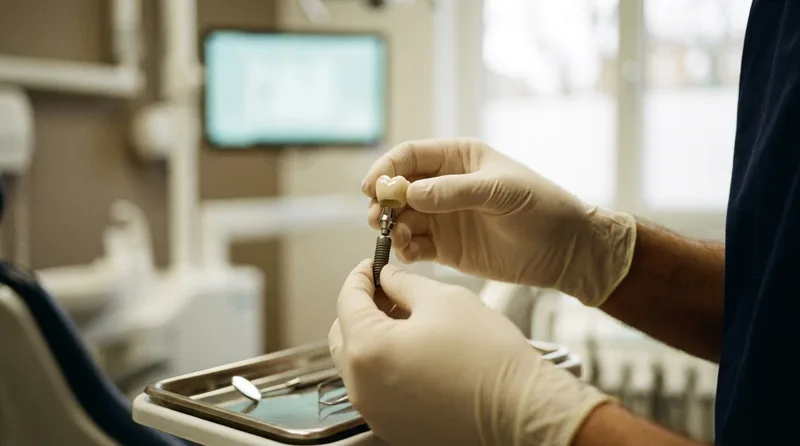
The three parts of an implant, from top to bottom
General guidance. Actual lifespan depends on your bite, habits, and care.
This layered design is one of the implant's quiet advantages. If the crown wears out, your dentist swaps the visible part while the foundation stays put. That's usually a simpler visit than redoing a bridge, which can involve the neighboring teeth too.
The abutment sits in between and usually goes unnoticed for years. If it ever loosens or wears, it can typically be tightened or replaced in a short visit, again without touching the implant in the bone.
Crown material matters as well. Molars handle the heaviest chewing forces, so the crown on a back implant may show wear sooner than one in front. Your dentist chooses materials with that in mind.
The biggest factors in implant lifespan are daily oral hygiene, gum and bone health, smoking, teeth grinding, conditions like diabetes, and keeping up with checkups. Most of these are within your control, which is why two people with identical implants can see very different results over the years.
How much each factor can affect implant lifespan
| Factor | Impact |
|---|---|
| Daily cleaning around the implant | ●●● |
| Smoking | ●●● |
| Gum disease history | ●●● |
| Teeth grinding or clenching | ●●● |
| Uncontrolled diabetes | ●●● |
| Implant location (front vs. back) | ●●● |
More dots means a bigger potential effect. General guidance only.
Gum health deserves special attention. Plaque around an implant can inflame the gums and, over time, the bone that holds it. That condition, called peri-implantitis, is the most common reason implants fail years after placement.
Failure is uncommon, but it helps to know what to watch for. We cover the signs of dental implant failure in a separate guide, including what to do if something feels off.
Over time, implants usually outlast other tooth replacement options. Complete dentures typically need replacing every five to seven years, and bridges depend on the health of the teeth supporting them. An implant post, by contrast, can last decades, with only the crown needing occasional replacement.
| Typical lifespan | What usually needs redoing | |
|---|---|---|
| Dental implant | Post often lasts a lifetime | The crown, after many years |
| Bridge | Many years | The bridge, if a supporting tooth has problems |
| Complete denture | About 5-7 years | Relines along the way, then a new set |
That's why implants, despite costing more upfront, often work out well over a lifetime. If you'd like the full picture, our guide to implants compared with bridges and dentures walks through cost, comfort, and how to choose.
You can help implants last longer by cleaning around them every day, seeing your dentist for regular checkups and cleanings, not smoking, wearing a night guard if you grind, and avoiding habits like chewing ice. These steps protect both the crown and the gum and bone that hold the implant in place.

A daily routine that protects your implant
Brush twice a day
Use a soft-bristled brush and pay close attention to the gumline around the implant.
Clean between teeth daily
Floss, interdental brushes, or a water flosser help remove plaque where a brush can't reach.
Keep regular cleanings
Professional cleanings and exams catch early gum changes before they become a problem.
Protect against grinding
A custom night guard takes pressure off the crown if you clench or grind at night.
Skip hard habits
Chewing ice, biting pens, or opening packages with your teeth can chip a crown.
Checkups matter more than most people expect. An implant can't get a cavity, but the gum around it can become inflamed without obvious symptoms. During a cleaning, your hygienist uses instruments that are gentle on implant surfaces and checks the gum and bone around the implant, sometimes with an X-ray. Catching small changes early is one of the simplest ways to protect your investment.
Helps implants last
Shortens implant life
These habits line up with the ADA's guidance on implant care, and the MouthHealthy overview of dental implants is a good plain-language refresher.
Related: Heavy grinding can shorten the life of implant crowns. Night guards for teeth grinding →
Yes. Implant crowns, bridges, and attachments we make come with a written warranty: if the restoration we crafted breaks or fails under normal use during its coverage period, we repair or replace it at no cost to you. The implant post itself is covered under your written treatment plan.
Covered by our written warranty
Covered in your treatment plan
We stand behind the dentistry we do, in writing. Ask for the warranty details for your specific restoration during your consultation, so you know exactly what's covered and for how long.
Want implants that are built to last?
Your consultation includes an exam, imaging, a written plan, and clear warranty details for the restoration we'd make for you.
Book a Consultation →For most people, yes. How long do dental implants last? Often decades, which means the cost spread over the years can compare well with options that need regular replacement. Implants are especially worth it if you value a natural feel, want to protect your jawbone, and can commit to daily care.
Think about cost per year rather than the first bill. A denture replaced every five to seven years, plus relines in between, adds up over a few decades. A bridge may need redoing if a supporting tooth develops problems. An implant has a higher starting cost, but if the post lasts for decades and only the crown is refreshed once or twice, the yearly cost can end up surprisingly competitive.
An implant is less a one-time purchase and more a long-term partnership between good dentistry and good daily habits.
They aren't the right fit for everyone. Some health conditions, heavy smoking, or limited bone can tip the balance toward another option, at least for now. An honest exam is the only way to know.
Patients from Peterborough, Jaffrey, Dublin, Hancock, and across the Monadnock region ask us this every week. Dr. Muhammad Rahim and Dr. Jasper Ainslie will look at your bone and gums, explain what would help your implant last, and give you a written plan with no pressure.
Results may vary. Please consult with your dentist at Peterborough Family Dental for personalized treatment recommendations.
Find Out If Implants Are a Long-Term Fit for You
Schedule a consultation at our Peterborough, NH office. We'll review your bone and gum health and explain what to expect over the years.
Request an Appointment →Prefer to talk it through first? Our front desk opens at 7 AM.
Call (603) 924-3664 →
Dr. Muhammad Rahim, DMD
Dentist · Peterborough Family Dental & Implant Center
Peterborough, NH dentist providing gentle general, cosmetic, restorative, and implant dentistry for the whole family.
Was this article helpful?
Implants also last well in older adults. A review of patients aged 65 and older found 96.2% survival at five years, and researchers concluded age alone shouldn't limit treatment. Overall health, bone quality, and the ability to keep the implant clean matter more than age.
Our Peterborough team is happy to answer questions and get you on the calendar.


